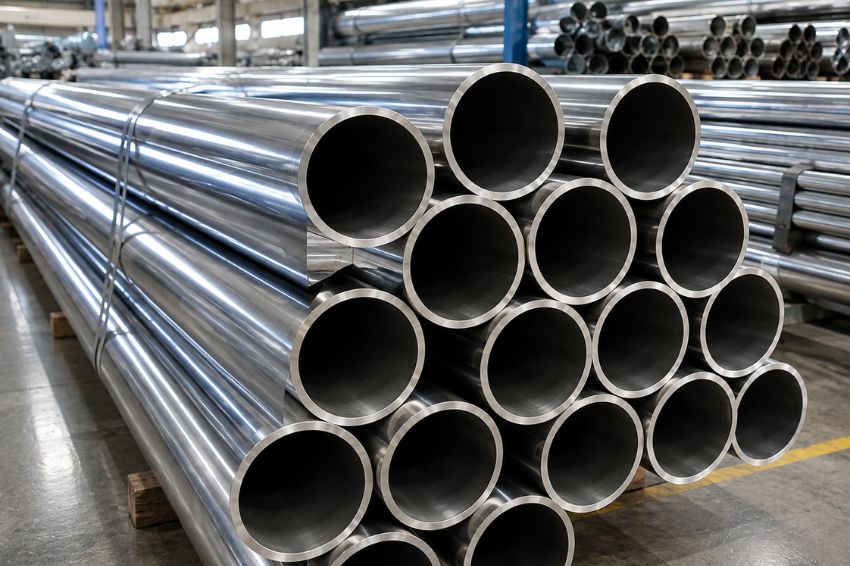
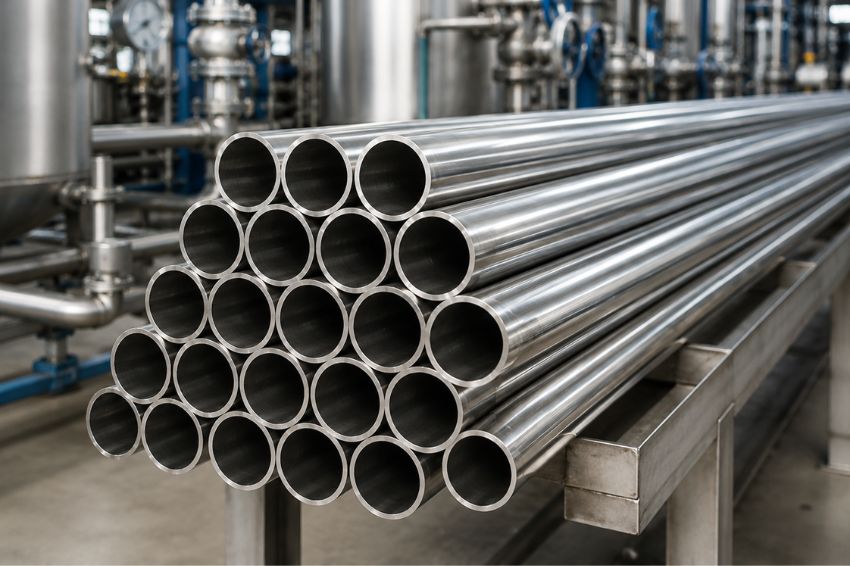
Stainless steel tubes are important parts of various industries. They carry fluids in chemical plants, support frames in buildings, move gases in refineries, and even guide food and drinks safely through processing lines. Grades like 304 and 304L stand out because they offer better strength, corrosion resistance, and easier fabrication than others. Still, many buyers mix them up, which often leads to the wrong choice on site.
For engineers, fabricators, and purchasing teams, knowing the small gap between 304 and 304L matters. A welded joint, a corrosive fluid, or a long service life can turn that gap into a real problem. This blog breaks it down in a simple way so you can choose the right tube for the job. And if you are looking for a reliable stainless steel tubes supplier, our team at Piyush Steel is here to support your project from start to finish.
What Is 304 Stainless Steel?
304 stainless steel is the most widely used grade in the austenitic family. It consists of 18% chromium and 8% nickel, with iron as the balance and small trace elements. This composition gives the material good resistance to rust and staining, while still keeping it strong and easy to shape.
In terms of performance, 304 has good tensile strength and holds up well under everyday industrial stress. It also resists oxidation when exposed to air, water, and many chemicals. Due to this, 304 SS tubes are found in food processing plants, building structures, kitchen equipment, and chemical piping.
What Is 304L Stainless Steel?
304L SS is a slightly better version of 304. The “L” stands for low carbon. While standard 304 allows up to 0.08% carbon, 304L limits this to about 0.03%. This small change has a big effect when welding enters the picture.
The lower amount of carbon reduces the risk of carbide build-up along the grain boundaries during welding. This reduces the chance of intergranular corrosion. For this reason, 304L stainless steel tubes are widely used in chemical tanks, welded structures, and pipelines. Its mechanical strength is slightly lower than 304, but this difference is hardly noticeable in real-world jobs.
Key Differences Between 304 and 304L SS Tubes
The main difference between these two grades is the carbon content. 304L has a lower amount of carbon, which changes how the metal behaves when heat is applied during welding. This makes 304L the safer choice when heavy or repeated welding is part of the job. With standard 304, welding can sometimes lead to carbide precipitation, which opens the door to corrosion in the heat-affected zones.
Corrosion resistance in normal service is high for both grades. Still, after welding, 304L holds up a little better in aggressive or chemical-rich environments. When it comes to mechanical properties, 304 has slightly higher tensile strength to take a bit more load.
When it comes to price and availability, the gap is narrow. Both are widely stocked by a good supplier, though 304 is often easier to find in standard sizes. Heat treatment limits are also similar, yet 304L performs more steadily when heat from welding has been part of the process.
Performance Comparison Table
| Feature | 304 | 304L |
| Carbon % | Around 0.08 | Approximately 0.03 |
| Corrosion resistance | High | Slightly higher after welding |
| Weldability | Good | Excellent |
| Applications | General purpose | Welded structures, chemical tanks |
| Strength | Slightly higher | Slightly lower |
Pick based on how much welding is involved and how tough the service environment will be.
When to Use 304 Stainless Steel Tubes
304 stainless steel tubes fit best in general-purpose work where welding is limited or light. They are widely used in food and beverage lines, kitchen equipment, architectural frameworks, and standard piping systems. In these settings, the metal’s strong resistance to rust and its clean surface matter more than post-weld corrosion control.
Because 304 is so common, it is also cost-effective for most everyday jobs. You get a material that is easy to source, easy to form, and strong enough for many structural and fluid-handling needs. If your project does not involve long weld runs or harsh chemicals, 304 is often a preferred choice that keeps things moving without extra cost or delay.
When to Use 304L Stainless Steel Tubes
304L is preferable when welding cannot be avoided. Due to its low-carbon structure, it is mainly found in heavy fabrication, long welded joints, and complex assemblies. It is also generally used in chemical plants, marine environments, and pipelines that carry aggressive fluids.
It is also suitable for applications that face intergranular corrosion. If your project demands reliability in a tough setting, 304L offers better performance. For buyers searching for a dependable 304L stainless steel tubes supplier, we at Piyush Steel keep a wide range in stock and support both standard and custom requirements with the same care.
Final Buying Considerations
Before you choose between 304 and 304L, look closely at how much welding your design involves and what kind of environment the tubes will face. Corrosive fluids, salt air, and heat all push the balance toward 304L. It is important that your supplier follows recognised standards such as ASTM or EN.
304 and 304L stainless steel tubes share a common base, yet their small carbon difference leads to different results. Choose 304 for everyday strength and value. Choose 304L when welding and corrosion resistance matter more. A clear choice now means longer, safer performance later.